

 Feed back
 Privacy Policy
In our data-driven era, the persistent fascination with Astrological Chart Interpretation presents an intriguing paradox. While modern science has demystified many cosmic phenomena, approximately 29% of American millennials still consult their natal charts for life guidance (Pew Research, 2022). This exploration of Astrological chart interpretation from a scientific and skeptical perspective aims to illuminate why this ancient practice continues to captivate despite lacking empirical validation.

The practice of Astrological Chart Interpretation originated in Mesopotamia around 600 BCE, where Babylonian priests meticulously recorded celestial movements on clay tablets. These early astrologers operated under the fundamental assumption that planetary alignments directly influenced earthly events—a principle that formed the cornerstone of all subsequent astrological systems. The Greek adaptation around 4th century BCE introduced the zodiac's twelve-fold division and the concept of natal charts, while Chinese astrologers developed parallel systems incorporating lunar cycles and elemental theory.
What modern practitioners often overlook is that ancient astrologers were simultaneously astronomers—the distinction between Astrology versus astronomy only emerged during the Scientific Revolution. The original Babylonian astrologer-astronomers would be astonished to see their observational records used for personal guidance rather than statecraft and agricultural planning.
The 21st century has witnessed an unprecedented democratization of Astrological Chart Interpretation, with mobile applications generating over 300 million personalized charts annually (Sensor Tower, 2023). This digital transformation has fundamentally altered engagement patterns:
This technological accessibility has created a feedback loop where increased participation validates the practice's perceived legitimacy, despite remaining scientifically unsubstantiated. The psychological mechanisms underlying this phenomenon warrant closer examination.
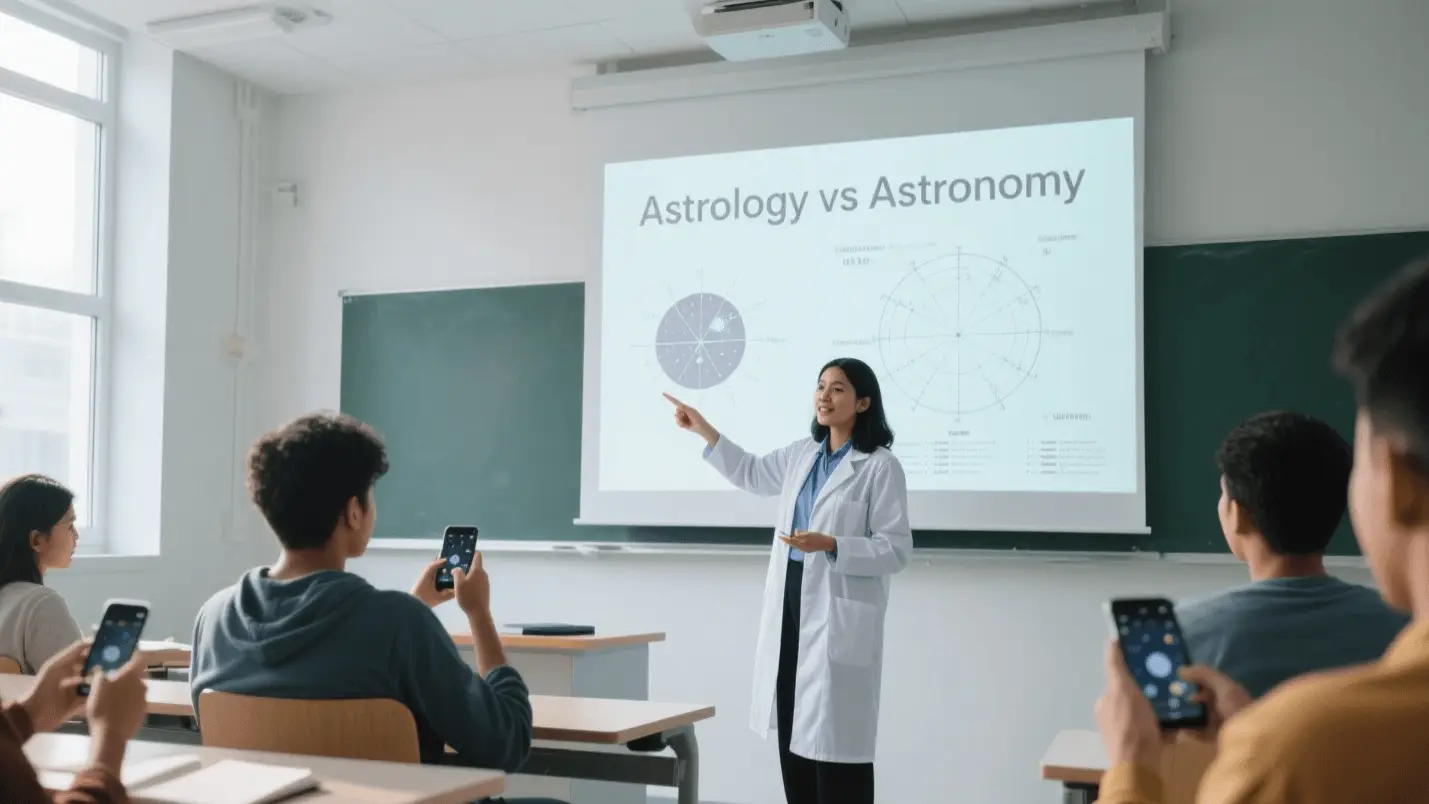
The fundamental conflict between Astrology versus astronomy stems from several irreconcilable differences:
These scientific realities render the physical basis of Astrological Chart Interpretation untenable, yet millions continue finding personal meaning in its symbolic systems.
The enduring appeal of Astrological Chart Interpretation becomes explicable through Psychological projection theory and related cognitive biases:
Psychological Mechanism
| Effect on Astrological Belief | |
|---|---|
| Barnum Effect | Accepting vague descriptions as personally specific |
| Confirmation Bias | Remembering "hits" while forgetting "misses" |
| Narrative Persuasion | Finding meaning in storied explanations |
The 1949 Forer experiment demonstrated that individuals will accept generalized personality descriptions as remarkably accurate when presented as personalized analyses—a finding replicated in numerous contemporary studies. This explains why different people reading the same horoscope often feel it speaks directly to their unique circumstances.
Can Astrological Chart Interpretation inform career decisions?
While some consult astrological guidance for vocational choices, meta-analyses of longitudinal studies show no correlation between astrological indicators and career success (Journal of Vocational Behavior, 2021). The perceived accuracy stems from the Forer effect rather than predictive validity.
Why does Astrology versus astronomy confusion persist?
The historical entanglement of these disciplines creates ongoing confusion. Astronomy measures celestial phenomena, while astrology interprets their symbolic meaning—a distinction obscured by their shared celestial subject matter.
How does Psychological projection theory explain zodiac identification?
Individuals unconsciously project their self-concept onto astrological descriptions, then perceive these projections as external validations of their identity—a process amplified by social reinforcement.
Disclaimer: The content presented regarding Astrological Chart Interpretation is for informational purposes only and should not be considered as professional advice. Consult qualified experts for decisions related to mental health, career planning, or personal development. The author disclaims any liability for actions taken based on this content.
Sophia Chen
|
2025.08.12


