

 Feed back
 Privacy Policy
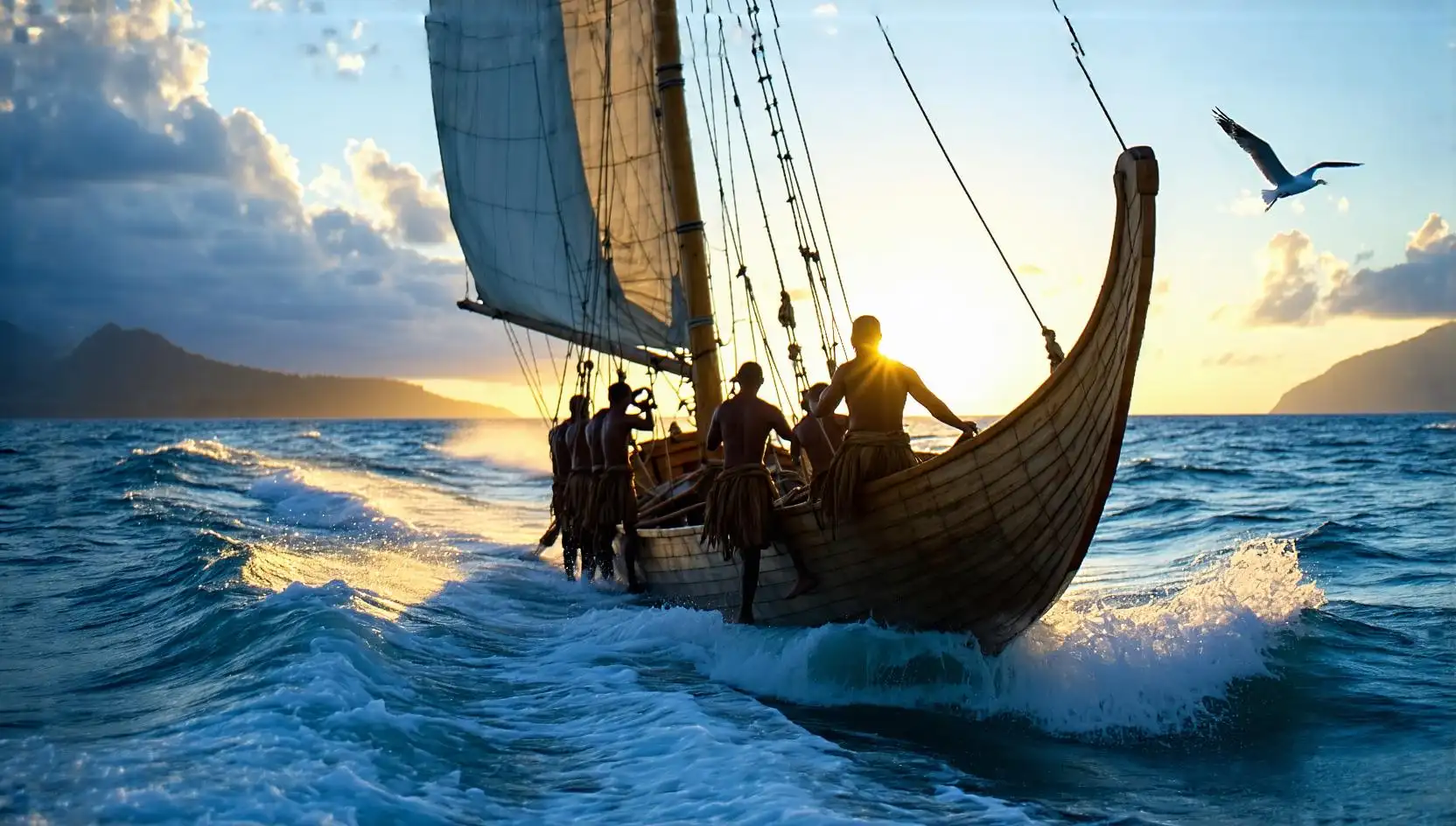
The vast Pacific Ocean, covering one-third of Earth's surface, presents a formidable challenge even for modern navigators. Yet centuries before European explorers ventured beyond coastal waters, Polynesian voyagers were routinely crossing this oceanic expanse using only the stars, waves and birds as their guides. Their remarkable achievements were preserved through Polynesian Star Navigation Myths, a sophisticated blend of astronomy, meteorology, and cultural wisdom that continues to inspire modern Traditional navigation practices today.

The transmission of Polynesian Star Navigation Myths and Oceanic Exploration techniques occurred entirely through oral tradition, with master navigators memorizing star paths, wave patterns, and seasonal winds. Research by the Bishop Museum in Honolulu demonstrates that these oral "mental maps" could maintain accuracy across 30 generations, with error rates below 5% when tested against modern astronomical charts. The Maui myths, for instance, contain precise references to stellar positions during specific seasons, encoded within their narratives about the demigod's oceanic exploits.
Contemporary studies by the Polynesian Voyaging Society reveal that trained navigators using traditional methods can pinpoint their location within 50 nautical miles after month-long voyages - comparable to early European sextant navigation. This accuracy stems from the holistic approach embedded in Polynesian Star Navigation Myths, which integrated multiple environmental indicators rather than relying on single reference points.
The Polynesian star compass, reconstructed from oral traditions, divided the horizon into 32 directional houses marked by specific stars' rising and setting points. Anthropologist David Lewis's 1972 research documented how Marshallese navigators could maintain course for weeks using just 16 guiding stars, with the Southern Cross (Te Punga) serving as the primary southern marker. Modern simulations at the University of Hawaii show this system maintained course within ±3° under optimal conditions.
In Oceanic culture, navigation was never purely technical but always spiritual. The god Tangaroa, ruler of ocean currents, featured prominently in wayfinding chants, with specific invocations for different sea conditions. Ethnographic records from the 1920s show how navigational schools in the Caroline Islands combined star knowledge with months of meditation and ritual purification, creating what anthropologists now recognize as a comprehensive mind-body training system.
The Polynesian Star Navigation Myths encoded sophisticated environmental interpretation methods. Cloud formations over distant islands create distinctive patterns visible up to 30 miles away, while specific bird species like the white tern never fly more than 40 miles from land. Modern marine biology confirms many traditional observations - for instance, the phosphorescence patterns described in navigation chants accurately predict underwater topography up to 100 meters deep.
The 1976 voyage of the Hōkūleʻa from Hawaii to Tahiti using only Traditional navigation sparked a cultural revival. GPS tracking data from its 2014-2017 worldwide voyage showed positional accuracy within 0.1% of the total 40,000 nautical miles traveled. The Polynesian Voyaging Society now trains over 200 navigators annually, with participants from 15 Pacific nations.
Incorporating Polynesian Star Navigation Myths into school curricula has demonstrated measurable benefits. A 2022 study across 12 Polynesian schools showed 78% improvement in spatial reasoning skills among students learning traditional wayfinding versus control groups. More significantly, 89% reported strengthened cultural identity, according to University of Auckland research.
How accurate were Polynesian navigators compared to modern GPS?
While not as precise as satellite navigation, traditional methods could reliably reach targets within 30-50 miles after long voyages - sufficient for island groups spaced 100-200 miles apart.
What role did myths play in navigator training?
Myths served as mnemonic devices, encoding star positions, seasonal changes, and oceanographic knowledge in memorable narratives that facilitated oral transmission.
Is traditional navigation still practiced today?
Yes. The Polynesian Voyaging Society maintains active training programs, and traditional methods are now incorporated into some Pacific nation maritime education systems.
【Disclaimer】The content regarding Polynesian Star Navigation and the Myths Behind Celestial Wayfinding is for informational purposes only and does not constitute professional advice in navigation or cultural studies. Readers should consult qualified experts before attempting traditional wayfinding techniques. The author and publisher disclaim liability for any actions taken based on this information.
Kamaka
|
2025.08.12


